

Monday, October 18, 2010

POV—It’s Not as Unfair as You Thought

A lot of new writers I meet tend to get frustrated with the writing rules in regard to POV (Point of View). The unwritten rule is that the author is only allowed to write from the point of view of one character per scene. Many quote this as a rule that can NEVER be broken. But if you read any novels at all you’ll see it’s broken rather regularly—usually by well known writers.

  • So let me say first—be skeptical of anyone who quotes an ALWAYS or NEVER rule of writing. Off the top of my head, I can’t think of a single rule that can’t occasionally be broken for a good reason.
  • Second, let me be quick to add that you need to know how to work within the rules before you can effectively break them.
  • Third, here’s an important quote to remember. I’ve heard it attributed to several editors and I believe it’s applicable. “After you’ve made your first million you can make up your own rules—until then, you’ll follow ours.”
That little caveat out of the way let’s get down to the business of POV. A scene with correct POV allows the reader to know everything the POV character knows and thinks. It’s as if there were a camera attached to that one character’s head and it records everything. Conversely, that camera can’t record anything the POV character can’t see or experience. Let me show you what I mean by showing you what NOT to do. Here’s a common scene, one we can all visualize, written the way a beginner might write it.

Jill sat at the small table, twisting the napkin in her lap and trying not to stare every time the restaurant door opened. She couldn’t imagine why she’d let Susan talk her into a blind date, but she had and now here she sat, waiting for Nathan to show up. She forced as smile as the waiter refilled her water glass.

“Can I get you anything else while you wait?” Sam disliked waiting on a table with a blind date. His tip depended on so much he couldn’t control. If the date went well, great. If not . . . well all the excellent service in the world couldn’t make up for that.

Jill sat up a little straighter as a tall man approached her table. “Are you Jill?”

“Nathan?” She mentally crossed her fingers. Susan hadn’t exaggerated his good looks.

Sam scooted backward to let Nathan take a seat. “May I get you a drink?”

“Just water, thanks.” Relief quieted the butterflies in Nathan’s belly. Jill was quite beautiful—perhaps this wouldn’t be a waste of time after all.

This scene is a perfect example of HEAD HOPPING—a definite no-no in POV. Head hopping is where the reader knows the thoughts or is in the head of more than one character in a scene. You can see that in this scene we start out in Jill’s head, move to the waiter’s and end up in Nathan’s.

I can already hear the groaning from some of you. When I teach this workshop I barely get the example finished before these comments reach my ears.

“How else is the reader going to know what’s going on?”

“I have to be able to show what’s happening!”

In my humble opinion, Head Hopping is the lazy writer’s way to tell the story. Before you start throwing rotten tomatoes, let me explain. As an author we have an amazing ability—a gift even—we read minds, the minds of our characters. And we can be tempted to think that for the reader to truly understand and GET the story, we have to share this gift.

Not true. And here’s why. You and I go through life without one shred of mindreading ability. Yet, we’re able to GET what’s going on and figure out what’s happening. We’re not handicapped by this lack. In fact, most people I know get along better without it. As a writer, our job is to let the reader EXPERIENCE the details in a given scene and draw their own conclusions. If we write the sensory details well, they’ll have no trouble at all.

Here’s the same scene rewritten.

Jill sat at the small table, twisting the napkin in her lap and trying not to stare every time the restaurant door opened. She couldn’t imagine why she’d let Susan talk her into a blind date, but she had and now here she sat, waiting for a stranger to show up. She forced as smile as the waiter refilled her water glass.

“Can I get you anything else while you wait?” He fingered his order pad and let out a small sigh.

“No thank you.” Jill figured it couldn’t be easy to wait on a couple who were on a blind date. She caught a movement and sat up a little straighter as a tall man approached her table.

He cleared his throat. “Are you Jill?”

“Nathan?” She mentally crossed her fingers. Her friend hadn’t exaggerated his good looks.

Sam scooted backward to let Nathan take a seat. “May I get you a drink?”

“Just water, thanks.” Nathan grinned. “I have to admit I was worried.” He cocked an eyebrow. “But for once my brother was right on target.”

See, it is possible to convey what everyone's thinking without butchering POV. Here’s a quick check list to help round out the details.
  • Use all five senses.
  • Describe the setting details through the perception of the POV character.
  • Let the interesting parts of the story happen WITHIN the quotation marks.
  • Don’t be afraid to leave some things out—it will keep the reader interested in turning the page.
The key to POV is to trust yourself and trust your reader!

Monday, October 11, 2010

TO BE OR NOT TO BE: What is “passive” writing?

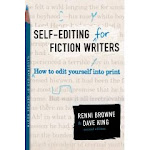
Before Darlene gets started, I wanted to invite all of you to Dave King's Facebook Fanpage for Self-Editing for Fiction Writers.

Hope to see you there.

Now, back to you, Darlene. :-)

***

Recently I presented a workshop for my local ACFW group on self-editing tips. For preparation, I took my current work in progress and made note of things I corrected in my own work.

The first problem I identified? “Avoid passive verbs when possible.”

But what is passive writing?

We can define passive writing grammatically:
• Verbs of being: To be. Also to seem, to appear, to feel, to become
• Passive tense: where the subject is acted upon instead of doing the acting. “I was hit by a car” vs. “I hit a car” (or “A car hit me.”)

But “avoiding” passive writing goes beyond those two rules of grammar.
• Another related rule of grammar involves participles: “She was going to the store.” Notice the “was.” Can we instead say, “She went to the store”?
• We avoid passive statements by showing rather than telling. Rather than saying “she felt sad,” we can show her feeling sad. (See last Monday’s blog for more on showing emotions.)
• “To have” often is used in a passive manner. “She had nine bags of groceries.” Instead of “had,” we could use bought, carried, gave away. Any one of those choices sharpens the meaning of the sentence.

Am I suggesting that writers never use passive voice? Of course not. As you may have noticed, I have used it liberally in this post. A few suggestions:
• One article I read said to keep passive voice to 2-3 occurrences a page. Most writers use more than that (some, many more).
• My personal rule: no more than one passive verb per paragraph.
• In critiquing, I don’t mention passive verbs in dialogue.
• During revisions, I use “search and replace” to change the font color of all passive verbs. That way I have to make a conscious decision about whether to keep or rewrite.

Do you have questions about “what is passive?” and “how to I rewrite this?” Feel free to share your questions and comments below.

Monday, October 4, 2010

After the Conference—Now What?

Many of us have gotten to attend a writing conference this year and many of us are just a couple of weeks back from the ACFW conference in Indianapolis. We’ve been inspired by the faculty and amazed at the ideas and abilities of fellow writers. While there, the adrenaline is pumping and we know when we get home we’ll be ready to take our own writing to the next level.

Then life happens. In the tired excitement of coming home, I have to reintegrate myself into my normal life. My family needs attention and I’ve missed them, too. Work has pressing deadlines and laundry has managed to multiply and take over my downstairs. These things tend to eat away at my time and energy until I’m so drained my conference experience seems like a lifetime ago.

By the time I catch my breath and return to writing I’ve found my confidence has deserted me and I’m left overwhelmed and confused. There’s so much I want to accomplish—revise my manuscript, start a blog, follow up with editors and agents. Instead I begin to listen that voice inside that says things like -

"That editor was just being nice—she isn’t really interested in my novel”
“My novel needs so much work, I ought to just start over.”
“Who am I trying to fool? There’s no way I could ever be a real writer.”

So how do I combat this downward spiral? I make a plan. I took time to time out my conference experience—I knew each day what classes I wanted and who I wanted to meet. I have to have that kind of a schedule to put into action the things I learned at the conference.

First make a list of what you came away wanting to do and prioritize what needs to be done first.
  • Start with thank you notes for those who took time to help you are a must. If you have an address send one through the mail, but often times you don’t have that information. If not, send a quick email—trust me—they’ll remember you took the time to say thank you.
  • Next evaluate your deadlines. Let’s say you have to revise a manuscript for one editor and send a proposal for another idea to a different editor. In this case, decide which one is easier to accomplish and start there.
  • Also look at the things you wanted to accomplish personally. Maybe you decided to spend more time each day writing. Or you committed to a personal word count goal. Don’t’ let those get pushed aside—start implementing the changes. This can be an incredible confidence builder.
  • What about other writers you met? Did you promise each other to stay in touch? Be brave and reach out to new friends.
  • Most important, accomplish something writing related every day. Some days that may be reading a chapter in a writing book. It might be reading a novel written by a writer you want to emulate.
Now it’s your turn. How do you combat the dark cloud that seems to descend after a conference?

Monday, September 27, 2010

KEEPING IT FRESH

I am currently working on a book I originally wrote in 1998. I polished it then to the best of my ability. I have read it several times. Time hasn’t given me objectivity; instead, I am more in love with the story than ever.

I am thankful for an honest critique partner, and she more or less hates it (she wouldn’t say so in so many words).

What’s the truth—a fairy tale romantic story or a dismal failure? Ultimately, my editor and my readers will decide.

But it brings up a problem many writers struggle with: how do we bring fresh eyes to a manuscript we’ve rewritten half a dozen times or more? Am I seeing this manuscript through the fond eyes of a mother or with a critical editor's eye?

I have no easy answers to that question, but here are a few ideas:
• Move on to another project if you have time.
• Leave this project alone between edits for as long as you can.
• If you have time and willing friends, give the manuscript to someone who has never seen it before.
• Read the manuscript aloud. Even better, have someone else read it aloud.
• Read the book from end to beginning.
• Dialogue with a trusted partner. What were you trying to do? How did it fail? (How) can it be fixed?
• Look at individual elements of the story, such as: character descriptions (consistent?); dialogue (each person unique?); timeline.

What ideas do the rest of you have? Do you struggle with this problem and if so, how do you handle it?

Sunday, September 19, 2010

I Don’t Get No Respect!

This seems to be a common refrain I hear from writers, especially those at the beginning of their career. They’ve finally worked up the courage to get serious about writing regularly and some of their closest family and friends won’t respect their time. They get calls during the times they’re writing and attitude if they don’t stop to talk. They hear comments that undermine their newfound confidence.

“You can do that, after all you stay home all day.”

“Oh come on, you’ve got nothing better to do.”

And my favorite. “It’s not like you have a real job.”

So what’s a writer to do?

First, take a deep breath and realize this problem isn’t unique to writers. It happens to everyone who works from home—I should know—my husband and I have shared a home office for the past eleven years. For some people an office isn’t an office if it isn’t off site. Not logical, but an all too common misconception. I’ve fought this battle—sometimes more successfully than others—and these are the strategies I’ve come up with.

  1. Make certain you’re setting the example you want followed. By that I mean keep regular hours. Notice I said regular hours—not to be confused with normal ones. For years I wrote with young children in the house. That meant writing in the afternoons and after they were in bed. Just because you’re working odd hours doesn’t mean you can’t have a schedule.
  2. Treat what you’re doing like you’re serious. If you blow off writing for shopping and lunch several times a week your friends and family won’t understand if you don’t stop for them.
  3. Be consistent. If you’re not accepting calls from your mother-in-law because you’re working, don’t spend the afternoon on the phone with your best friend. Stay focused on your writing. This is even more critical if your time is at a premium. 
  4. Recruit a support team. Instead of adversaries, enlist your friends and family to help you reach your writing goals. Communicate those goals, clearly and frequently. Ask for their help to reach them. After all, what mother doesn’t want to help her baby succeed!
  5. Share your victories. Let those who love you share in the joy of goals accomplished and milestones reached.
These five things have helped me immeasurably over the years. But they’re not a cure all. There will still be those who think what you do is just for fun and not work. Expect that, anticipate it even. Knowing it happens to everyone takes away a little bit of the sting. Most of all, don't let it stand in your way!

Monday, September 13, 2010

INTERVIEW WITH AN EDITOR

Many of our readers will be going to the American Christian Fiction Writers (ACFW) conference this week. Have fun! I hope to see you next year. This year I'm staying home to play grandma.

That also means many of you will be seeing an editor and/or an agent. You will talk with them at the dinner tables, in the hall, during an appointment. It's entirely possible all of your carefully practiced "elevator speeches" will fly out of your head. (It always does mine. I rarely get it in a single sentence and I've still managed to sell more than a dozen books.)

So I thought I would share some of my observations and experiences.
  • Your passion for your story will come through and impress the editor.
  • The editor is more interested in hearing from you than looking at the one sheet.
  • It doesn't hurt to mention why you think this story is a good fit for their company.
  • Bring samples of your writing. They won't take your chapters with them (probably) but they will read and get a sense of your ability to write.
  • Accept rejections with grace.
  • Don't feel you have to leave as soon as they say "no" (although you may). The appointment isn't only a sales pitch; it's also a chance to talk with an industry professional.
  • The fact you are at the conference speaks volumes about you. You are committed to learning and improving. Editors appreciate this; they will be more willing to look at things from you in the future, regardless of what happens this year.
Most of all ... relax. Be yourself. Share your heart. Build a friendship. And leave the results to the Lord.

Sunday, September 5, 2010

Feeling Emotional—Don’t Tell Anyone!

Instead show them.

Telling the story, instead of showing it, is one of the most common mistakes beginners make. During the first draft almost all of us, no matter how advanced, tend to tell a lot of the story. It’s only natural. This is the time when our manuscript comes together and telling allows us to develop the bones or structure of the story before we refine it into a compelling work of fiction. But beginners often stop the refining process too early. So how do we take a story from just bare bones? One of the best ways is to add depth by showing how our characters feel without naming the emotions.

Now, I know a lot of you are probably having the same reaction I did when I first heard it wasn’t a good idea to name an emotion. I had a rather loud conversation with the writing book that first shared this nugget of information.

“You have got to be kidding me! Who made up this stupid rule? How can I tell the reader what’s going on if I don’t use words like scared or angry?”

And there is the crux of the problem—beginning writers always default back to telling the story. Writing fiction is hard work. It takes a lot of time and effort to write a book and write it well. You already know this—after all that’s why you’re taking the time to read and study about how to improve.

Like I mentioned, I didn’t have a positive reaction to my first exposure to this convention. But now it’s an aspect of rewriting that I enjoy and even look forward to. I look on this as a challenge—a game of sorts. The best part of this game is that when I, the author wins, everybody else does too. Am I nuts? Absolutely, but I am, after all, a writer!

Let me give you some examples. I’ll start each out with an excerpt where I name the emotion. Then, in the second, I'll let you see how I changed it to let the reader name the emotion by interpreting the character’s actions.

Example 1
Emotions Named:
She began to cry as shame and anger warred inside. “I didn’t do anything wrong.” Her voice sounded hoarse as she tried to control her frustration.

Emotions Implied:
Tears flooded her eyes, making his features blur as she lifted her head and tried to focus. “I didn’t do anything wrong.” Her voice came out like a croak and she tried to clear her throat, but choked on the unshed tears.

The first excerpt tells the reader what’s going on. Granted, the writing is clear, but we’ve all heard the expression that a picture is worth a thousand words. The second excerpt is that picture. It invites the reader into the action and leaves them to draw their own conclusions.

Here’s another one.

Example 2
Emotions Named:
Manaen rose, her anger giving her strength as she faced her brother. “Do not think to intimidate me.” His arrogance amazed her even as it infuriated her. “I am not a child to be bullied. My Lord’s Spirit speaks to me as clearly as to you.”

Emotions Implied:
Manaen rose in response, her eyes almost even with his as she drew herself up to her full height, oblivious of her feminine garment. “Do not think to intimidate me.” Her jaw worked as she gritted her teeth. “I am not a child to be bullied. My Lord’s Spirit speaks to me as clearly as to you.”

And a final one.

Example 3
Emotions Named:
Rage sent Josiah shooting to his feet. “I tell you, Manaen, I’ve never witnessed any Elder behave in this manner.” Josiah paced, feeling like his world was collapsing. Confusion made him restless. “I just don’t understand.”

Emotions Implied:
He shot up from the desk, upsetting the chair. “I tell you, Manaen, I’ve never witnessed any Elder behave in this manner.” Josiah prowled through the briefing area of their quarters, picking things up and setting them down again. “I just don’t understand.”

Now it’s your turn. Take one of these two sentences and show us the emotion in place of naming it.

Example 1
Susan’s agony flooded through her as sorrow mingled with guilt. “What have I done?”

Example 2
“Hello? Who’s there?” Jenny’s fear reached a crescendo as the footsteps above moved toward the stairs.

I can hardly wait to read what you come up with!