Dear fellow writers and editors,
I'm sad to say, Tracy will no longer be able to grace us with her knowledge and wisdom. She had too much on her plate and needed to cut back.
Tracy, you will be greatly missed! Thank you for all your insight into editing and improving our prose. Thank you for all the feedback you've given to us on our works in progress. We wish you much success and hope you'll stop by and visit us as often as you can.
We'll miss you, Tracy!
Wednesday, March 24, 2010
Monday, March 15, 2010
Showing versus Telling
Show and tell. This is one of the most important rules in writing fiction. Always “show” the story, never “tell” it. Of course, there are times when passages of “telling” are necessary (i.e. in narrative summary). There are some incidences where it’s acceptable, such as in transitions. Or perhaps there’s a jump in time that needs to be conveyed. But for the most part, the more a writer “shows,” the better.
What is showing? Showing takes place in real time; we see things unfold as they happen. Showing shows us where we are, gives us a location we can picture. Then there’s action, something that happens, and with that comes dialogue.
Ever hear the saying: Actions speak louder than words? The same rule applies to writing. Actions bring characters to life, it makes your characters believable, and it makes us a part of the story and a part of them. We’ll learn more about a character and become more connected to them by what they do, rather than by what the narrator “tells” us they do. It also brings in the five senses: touch, taste, see, smell, and feel.
Here’s a brief example below. Both lines are saying the same thing, only one is “telling” and the other is “showing:”
TELLING: Michael was scared. But he tried to hide it.
SHOWING: Michael took a deep breath and puffed up his chest. But his hand trembled when he reached for the doorknob. He stuffed it in his pocket, then turned to his companion and chuckled.
Which lines engage you more as a reader? Notice the second lines show “action,” whereas the first lines “tell” what he’s feeling.
One tip I always give to clients on how to show and not tell is to start with the object and have it "do something." Another key is to cut the "was" phrases.
BEFORE: It was early in the morning. The sun was coming up over the horizon and shining on the crops of flax.
Here, the object is the sun. In the second sentence we begin with the "object," but we have that troublesome "was" phrase, which makes this passage "telling."
AFTER: The morning sun cast lances of light over the blue and purple valleys. A breeze carried the scent of flaxen crops and manure to the early risers.
Notice the deleted "was" phrases and how we start with the object and we have that object "do something." Also, notice how we had room to add more from the five senses, such as smell.
That example was a bit complicated, so let's break it down into something more simple.
BEFORE: The breeze was cold.
AFTER: The Canadian breeze sliced through his coat and nipped his skin.
Now, I'm not saying these can't be worded better, but the idea is to have the breeze "do something." In this case, the breeze is slicing and nipping.
Hope this has been helpful, and if anyone has something to add, please do!
Happy writing!
Sandi
What is showing? Showing takes place in real time; we see things unfold as they happen. Showing shows us where we are, gives us a location we can picture. Then there’s action, something that happens, and with that comes dialogue.
Ever hear the saying: Actions speak louder than words? The same rule applies to writing. Actions bring characters to life, it makes your characters believable, and it makes us a part of the story and a part of them. We’ll learn more about a character and become more connected to them by what they do, rather than by what the narrator “tells” us they do. It also brings in the five senses: touch, taste, see, smell, and feel.
Here’s a brief example below. Both lines are saying the same thing, only one is “telling” and the other is “showing:”
TELLING: Michael was scared. But he tried to hide it.
SHOWING: Michael took a deep breath and puffed up his chest. But his hand trembled when he reached for the doorknob. He stuffed it in his pocket, then turned to his companion and chuckled.
Which lines engage you more as a reader? Notice the second lines show “action,” whereas the first lines “tell” what he’s feeling.
One tip I always give to clients on how to show and not tell is to start with the object and have it "do something." Another key is to cut the "was" phrases.
BEFORE: It was early in the morning. The sun was coming up over the horizon and shining on the crops of flax.
Here, the object is the sun. In the second sentence we begin with the "object," but we have that troublesome "was" phrase, which makes this passage "telling."
AFTER: The morning sun cast lances of light over the blue and purple valleys. A breeze carried the scent of flaxen crops and manure to the early risers.
Notice the deleted "was" phrases and how we start with the object and we have that object "do something." Also, notice how we had room to add more from the five senses, such as smell.
That example was a bit complicated, so let's break it down into something more simple.
BEFORE: The breeze was cold.
AFTER: The Canadian breeze sliced through his coat and nipped his skin.
Now, I'm not saying these can't be worded better, but the idea is to have the breeze "do something." In this case, the breeze is slicing and nipping.
Hope this has been helpful, and if anyone has something to add, please do!
Happy writing!
Sandi
Monday, March 8, 2010
Preparing for a Writer's Conference
Spring ushers in the year's "conference season." Here's an article published a couple of years ago, but I hope it will be helpful to anyone going to conference this year - for the first time or the tenth.
Preparing for Your First Writer’s Conference
Conference season has arrived, and so have the nerves. The reservations are made, but your first writer’s conference is still weeks away. Utilize this time to make your first conference experience the most enjoyable, and the most useful.
1) Write two pitches for your project. Whether you’re writing the all-American novel, or a short magazine article, you need an “elevator” pitch and a longer one, usually called a “back cover blurb.” Condense your project into 25- and 50-word pitches. It’s not an easy task; take your time to get it right.
2) Practice giving the pitches. If you have critique partners, practice on each other. If not, practice with your spouse, your kids, your dog. Get so comfortable giving your pitch that it becomes a natural response when an editor asks, “What are you working on?”
3) Create a “one-sheet” to use as handouts to editors and publishers. If you have access to Microsoft Publisher, or any other type of graphic arts program, you can create a crisp layout conveying your ideas. You’ll find a One-Sheet handout on the http://www.writeintegrity.com/ Web site.
4) Order business cards. Several companies offer affordable options for cards so you won’t have to break the bank. Ordering two sets of cards provides a safety measure - you can give out the cards with your complete information to editors and business contacts who need all that information; distribute the more generic cards, with your email address and website, but no other personal information, to strangers who ask about your work.
5) Research the publishers and editors who’ll be attending the conference. Most conferences provide a list of professionals giving workshops, keynotes, appointments, and critiques so make use of the information. The conference may also provide a “most wanted” list from each participant, so you’ll know in advance who’s looking for your type of manuscript. Visit websites to learn about their current authors and projects, what types of projects they may be seeking and to get a general feel for the company.
6) Keep writing. A daily writing schedule - working on the project you’re pitching or a new one - will keep you focused.
7) Prepare your wardrobe. Check the conference information to determine how formal or how casual the event will be, and then make sure your wardrobe matches. You want to appear professional and together; others will get their first impression of you from your wardrobe so you don’t want to over- or under-dress. Some conferences host an awards banquet; find out if it’s a formal occasion before you arrive.
8) Keep your expectations in check. You’ll probably have time with agents, editors, and publishers and some may even be interested in your work. But if they aren’t interested, this isn’t the end of your career. Attend workshops and seminars, take notes, and seek advice. Learn as much as you can about the craft of writing, and know that the education never ends.
9) Stock up on thank-you cards. Immediately after the conference, you’ll want to send notes to all who helped you, advised you, offered critiques or assistance.
10) Most of all - enjoy the experience. Know this is a time to learn, listen, study, but it’s also a time to make new friends and contacts for the future.
1) Write two pitches for your project. Whether you’re writing the all-American novel, or a short magazine article, you need an “elevator” pitch and a longer one, usually called a “back cover blurb.” Condense your project into 25- and 50-word pitches. It’s not an easy task; take your time to get it right.
2) Practice giving the pitches. If you have critique partners, practice on each other. If not, practice with your spouse, your kids, your dog. Get so comfortable giving your pitch that it becomes a natural response when an editor asks, “What are you working on?”
3) Create a “one-sheet” to use as handouts to editors and publishers. If you have access to Microsoft Publisher, or any other type of graphic arts program, you can create a crisp layout conveying your ideas. You’ll find a One-Sheet handout on the http://www.writeintegrity.com/ Web site.
4) Order business cards. Several companies offer affordable options for cards so you won’t have to break the bank. Ordering two sets of cards provides a safety measure - you can give out the cards with your complete information to editors and business contacts who need all that information; distribute the more generic cards, with your email address and website, but no other personal information, to strangers who ask about your work.
5) Research the publishers and editors who’ll be attending the conference. Most conferences provide a list of professionals giving workshops, keynotes, appointments, and critiques so make use of the information. The conference may also provide a “most wanted” list from each participant, so you’ll know in advance who’s looking for your type of manuscript. Visit websites to learn about their current authors and projects, what types of projects they may be seeking and to get a general feel for the company.
6) Keep writing. A daily writing schedule - working on the project you’re pitching or a new one - will keep you focused.
7) Prepare your wardrobe. Check the conference information to determine how formal or how casual the event will be, and then make sure your wardrobe matches. You want to appear professional and together; others will get their first impression of you from your wardrobe so you don’t want to over- or under-dress. Some conferences host an awards banquet; find out if it’s a formal occasion before you arrive.
8) Keep your expectations in check. You’ll probably have time with agents, editors, and publishers and some may even be interested in your work. But if they aren’t interested, this isn’t the end of your career. Attend workshops and seminars, take notes, and seek advice. Learn as much as you can about the craft of writing, and know that the education never ends.
9) Stock up on thank-you cards. Immediately after the conference, you’ll want to send notes to all who helped you, advised you, offered critiques or assistance.
10) Most of all - enjoy the experience. Know this is a time to learn, listen, study, but it’s also a time to make new friends and contacts for the future.
Sunday, February 28, 2010
Breaking Up Is Hard To Do
Let's talk about dialogue. Sometimes we get so caught up in our dialogue that we forget to add beats of action, internal monologue and descriptions of the scene. This leaves us with dialogue where the characters sound like they're in a rush, and by the time we get to the end, we (the reader) feel out of breath.
Some writers tend to put all the important information into one paragraph. This is what I call an information dump. Instead, what we need to do is sprinkle the information throughout the text.
Allow me to provide a before and after example of how we can do this.
In the following example, we'll read what dialogue sounds like without any beats of action or internal monologue and very little descriptions of the scene. The following excerpt is taken from a historical western. We're in Anna's point of view in a dining car on a train.
BEFORE:
“May I join you?" the man asked. "There are no available tables in this car, and I see you are nearly finished.”
“Oh yes, please, sit down."
“The name's Steven Kane.”
Anna introduced herself, then stood and prepared to gulp down the rest of her tea.
“No need to rush. Take your time, enjoy your tea.” The man sat across from her.
“Thank you.” She settled back into her seat and tried to relax.
“And what’s your destination, if I may ask?”
“Denver City.”
“That’s where I’m going. So, you’ll be taking the stage from Julesburg.”
“No. I’ll be taking the stagecoach from Cheyenne.”
“Cheyenne? There’s nothing in Cheyenne. Why would you go that route? Are you meeting someone?”
“I was told in New York that I could take a coach from Cheyenne to Denver. It’s much closer, isn’t it? I mean, closer than Julesburg is to Denver City.”
“Hmmm. I suppose you’re right, it is closer. But you still have to go a ways on the train, and I know for a fact that the service from Julesburg is much faster. The stagecoach from Julesburg to Denver City has won competitions for its speed. You could get off with me. I can assure your safety. That is, if you’re not meeting someone.”
“Thank you for your kind offer, Mr. Kane, but I’m meeting my fiancĂ©.” With that, she stood and bid him good day.
***
If you're not out of breath by this time, then you're likely bored out of your mind. Let's see how much richness we can add to our prose by breaking up our dialogue with some action and internal monologue. Not only that, notice how the added detail tells another part of the story.
AFTER:
Several days later and long past Chicago, Anna sat in the dining car, watching the scenery unfold before her eyes. The landscape spread out for miles. Occasionally, she’d spot a small farm or a ranch, but most of the land was wide-open spaces with fields and rolling hills of yellow, brown and green. She sipped her tea, noticing the empty plate before her. She hadn’t eaten this well in a long time.
“May I join you?”
She looked up.
A young gentleman with a black handlebar mustache stood next to her table. He smiled, put his hands behind his back and rocked on his feet. “There are no available tables in this car, and I see you are nearly finished.”
“Oh yes, please, sit down,” she said, ashamed she hadn’t spoken sooner.
“Steven Kane.” He tipped his hat.
Anna introduced herself, then stood and prepared to gulp down the rest of her tea.
“No need to rush. Take your time, enjoy your tea.” The man sat across from her.
“Thank you.” She settled back into her seat and tried to relax. She’d never shared a table with a man before.
“And what’s your destination, if I may ask?”
“Denver City.”
“That’s where I’m going.” The man’s smile broadened. “So, you’ll be taking the stage from Julesburg.”
Puzzled, she glanced up at him. “No. I’ll be taking the stagecoach from Cheyenne.”
“Cheyenne? There’s nothing in Cheyenne. Why would you go that route?” His brows rose in question. “Are you meeting someone?”
She took a sip from her tea. She didn’t want him to know she wasn’t meeting anyone, and yet, what if she were about to get off at the wrong stop?
“I was told in New York that I could take a coach from Cheyenne to Denver.” She cleared her throat, trying not to sound too ignorant. “It’s much closer, isn’t it? I mean, closer than Julesburg is to Denver City.” She recalled all her studies of the railroads, and where they were being built, and according to the map, Cheyenne was definitely closer to Denver.
“Hmmm.” Mr. Kane rubbed his chin. “I suppose you’re right, it is closer. But you still have to go a ways on the train, and I know for a fact that the service from Julesburg is much faster. The stagecoach from Julesburg to Denver City has won competitions for its speed.”
His eyes swept over her and back to her face. “You could get off with me. I can assure your safety. That is, if you’re not meeting someone.”
She forced a smile, shifting uncomfortably under his gaze. “Thank you for your kind offer, Mr. Kane, but I’m meeting my fiancĂ©.” With that, she stood and bid him good day. Her conscience bothered her dreadfully for having told such a blatant lie.
***
Notice how once details are added to a scene we can now see the scene, feel it, touch it, and even taste it. It also gives us a look into the characters and their fears, struggles, triumphs. All of these things are what help us to lose ourselves in a story.
Let's play around with the dialogue below. How would you add richness to the following text? Have fun with it, and show us all the different directions a writer can take it.
"I can't."
"But it's not far."
"When you said we were going to FILL IN SPACE, I didn't know you meant this."
Some writers tend to put all the important information into one paragraph. This is what I call an information dump. Instead, what we need to do is sprinkle the information throughout the text.
Allow me to provide a before and after example of how we can do this.
In the following example, we'll read what dialogue sounds like without any beats of action or internal monologue and very little descriptions of the scene. The following excerpt is taken from a historical western. We're in Anna's point of view in a dining car on a train.
BEFORE:
“May I join you?" the man asked. "There are no available tables in this car, and I see you are nearly finished.”
“Oh yes, please, sit down."
“The name's Steven Kane.”
Anna introduced herself, then stood and prepared to gulp down the rest of her tea.
“No need to rush. Take your time, enjoy your tea.” The man sat across from her.
“Thank you.” She settled back into her seat and tried to relax.
“And what’s your destination, if I may ask?”
“Denver City.”
“That’s where I’m going. So, you’ll be taking the stage from Julesburg.”
“No. I’ll be taking the stagecoach from Cheyenne.”
“Cheyenne? There’s nothing in Cheyenne. Why would you go that route? Are you meeting someone?”
“I was told in New York that I could take a coach from Cheyenne to Denver. It’s much closer, isn’t it? I mean, closer than Julesburg is to Denver City.”
“Hmmm. I suppose you’re right, it is closer. But you still have to go a ways on the train, and I know for a fact that the service from Julesburg is much faster. The stagecoach from Julesburg to Denver City has won competitions for its speed. You could get off with me. I can assure your safety. That is, if you’re not meeting someone.”
“Thank you for your kind offer, Mr. Kane, but I’m meeting my fiancĂ©.” With that, she stood and bid him good day.
***
If you're not out of breath by this time, then you're likely bored out of your mind. Let's see how much richness we can add to our prose by breaking up our dialogue with some action and internal monologue. Not only that, notice how the added detail tells another part of the story.
AFTER:
Several days later and long past Chicago, Anna sat in the dining car, watching the scenery unfold before her eyes. The landscape spread out for miles. Occasionally, she’d spot a small farm or a ranch, but most of the land was wide-open spaces with fields and rolling hills of yellow, brown and green. She sipped her tea, noticing the empty plate before her. She hadn’t eaten this well in a long time.
“May I join you?”
She looked up.
A young gentleman with a black handlebar mustache stood next to her table. He smiled, put his hands behind his back and rocked on his feet. “There are no available tables in this car, and I see you are nearly finished.”
“Oh yes, please, sit down,” she said, ashamed she hadn’t spoken sooner.
“Steven Kane.” He tipped his hat.
Anna introduced herself, then stood and prepared to gulp down the rest of her tea.
“No need to rush. Take your time, enjoy your tea.” The man sat across from her.
“Thank you.” She settled back into her seat and tried to relax. She’d never shared a table with a man before.
“And what’s your destination, if I may ask?”
“Denver City.”
“That’s where I’m going.” The man’s smile broadened. “So, you’ll be taking the stage from Julesburg.”
Puzzled, she glanced up at him. “No. I’ll be taking the stagecoach from Cheyenne.”
“Cheyenne? There’s nothing in Cheyenne. Why would you go that route?” His brows rose in question. “Are you meeting someone?”
She took a sip from her tea. She didn’t want him to know she wasn’t meeting anyone, and yet, what if she were about to get off at the wrong stop?
“I was told in New York that I could take a coach from Cheyenne to Denver.” She cleared her throat, trying not to sound too ignorant. “It’s much closer, isn’t it? I mean, closer than Julesburg is to Denver City.” She recalled all her studies of the railroads, and where they were being built, and according to the map, Cheyenne was definitely closer to Denver.
“Hmmm.” Mr. Kane rubbed his chin. “I suppose you’re right, it is closer. But you still have to go a ways on the train, and I know for a fact that the service from Julesburg is much faster. The stagecoach from Julesburg to Denver City has won competitions for its speed.”
His eyes swept over her and back to her face. “You could get off with me. I can assure your safety. That is, if you’re not meeting someone.”
She forced a smile, shifting uncomfortably under his gaze. “Thank you for your kind offer, Mr. Kane, but I’m meeting my fiancĂ©.” With that, she stood and bid him good day. Her conscience bothered her dreadfully for having told such a blatant lie.
***
Notice how once details are added to a scene we can now see the scene, feel it, touch it, and even taste it. It also gives us a look into the characters and their fears, struggles, triumphs. All of these things are what help us to lose ourselves in a story.
Let's play around with the dialogue below. How would you add richness to the following text? Have fun with it, and show us all the different directions a writer can take it.
"I can't."
"But it's not far."
"When you said we were going to FILL IN SPACE, I didn't know you meant this."
Monday, February 22, 2010
Do Your Settings Need Help?
This week, I decided to do something different. Monday, March 1, Lena Nelson Dooley will begin teaching an online course through WIES Workshops entitled "Taking Your Settings to the Next Level." I recently interviewed Lena about this course, and thought I'd share it here with you. After the interview, I'll ask you to share with us.
First, let me share a little with you about Lena.

Lena Nelson Dooley is a multi-published, award-winning author with more than 650,000 books in print. Although her brand is Characters Who Grip Your Heart, her books are a rich tapestry of setting, too. She's been a full-time author, speaker since her second book released in 2002. She's taught online classes for ACFW as well as doing workshops for writing groups and at both regional and national conferences. Lena's next book, Love Finds You in Golden New Mexico, will release May 1.
A native of Arkansas, she moved to Texas during college. She married there and still lives in Texas with the love her her life. They enjoy spending time with family and friends, traveling, and movies. Active in church, Lena volunteers in the church bookstore and serves on the Altar Ministry team.
TR: Lena, why are settings so important?
LND: A sense of setting lets the reader settle into the story without wondering where the characters are. They can comfortably enjoy watching the story take shape in their mind.
TR: Why are settings difficult to master?
LND: Many people don't understand the subtlety of adding setting. During the course, we'll talk about the nuances.
TR: How does an author know when to make the setting a real place, or when to create a fictional one?
LND: This depends on a number of things, and we'll discuss them during the class.
TR: I've read books that are so generic in setting, the action could take place anywhere. But the books I remember most create a sense of place for me - the author makes the reader want to go to the setting, even if it is fictional. Will your course help the writer accomplish that?
LND: Most definitely!
TR: What was your favorite setting to write in which book? Why was it your favorite?
LND: That's hard to answer. I loved each setting for different reasons. I will use many of the settings from my books as examples during the course.
TR: What was your most difficult setting? Why?
LND: Probably Pirate's Prize, set in 1804.
TR: How will the writer benefit from taking your course?
LND: They will learn how to establish a setting foundation and use it through the whole course.
Thanks, Lena, for taking the time to share with us. Registration is currently in progress for Lena's course, Taking Settings to the Next Level. Find all the details and registration information here.
Okay, reader, now it's your turn to tell us what you think about settings. Choose any or all of the questions below and provide your answers in the comments.
First, as a writer: What causes you the most trouble when creating settings for your books? Do you have any tips you'd like to share with us about creating those settings? Have you had a favorite setting for your own stories? What was it, and why was it your favorite? What about least favorite, and why?
Second, as a reader: Do you like rich settings? What's one setting you remember most in a book? Why? Does a vivid setting cause you to become more involved in the story? Or perhaps like/dislike the characters more strongly, depending on the setting?
I look forward to your thoughts.
Monday, February 15, 2010
Prepositions Aren't Always Fun
Third grade was an exciting time for me, even though much of my childhood memory is blank. When we got to third grade, we were issued ENGLISH books! I still remember its orange cover and black lettering, and was disappointed that my book was a little ragged on the edges, but I loved its contents.
I was one of those kids who actually LIKED diagramming sentences, and I loved finding all the prepositions because it was a small list of words I could memorize.
But as I became a writer and then an editor, I learned that prepositions aren’t always a writer’s best friend, especially when numerous prepositional phrases are used in a single run-on sentence, like this extreme example:
How many prepositional phrases can you identify?* How many would you remove or change? Yes, this is one of those paragraphs that would probably get scrapped completely – pulling only a few choice nuggets of information from it.
Scan your manuscript. Read it aloud. Focus your words. Tighten. Remember as you write that the reader is not in YOUR head, and can’t see the story unfolding. (This is a very good thing for most of us.) You unfold it for them with logic, clarity, and purpose.
*P.S. There are 22 – did you find them all?
I was one of those kids who actually LIKED diagramming sentences, and I loved finding all the prepositions because it was a small list of words I could memorize.
But as I became a writer and then an editor, I learned that prepositions aren’t always a writer’s best friend, especially when numerous prepositional phrases are used in a single run-on sentence, like this extreme example:
Looking through the store window on her right during her lunch break, Drucila spotted the dress of her dreams in pale yellow before she pirouetted right there on the sidewalk in broad daylight because she was so happy and in love she could just about die from excitement that tomorrow under the romantic stars she would become Matt’s wife in spite of what their parents said and they would live happily ever after just like in the fairy tales read to her by her mother since she was only a child still in diapers and sucking on a bottle from her crib in the evenings before bedtime.
How many prepositional phrases can you identify?* How many would you remove or change? Yes, this is one of those paragraphs that would probably get scrapped completely – pulling only a few choice nuggets of information from it.
Scan your manuscript. Read it aloud. Focus your words. Tighten. Remember as you write that the reader is not in YOUR head, and can’t see the story unfolding. (This is a very good thing for most of us.) You unfold it for them with logic, clarity, and purpose.
*P.S. There are 22 – did you find them all?
Monday, February 1, 2010
"Breaking the Rules" by Dave King
Breaking the Rules
Sometimes, you need to ignore even the best advice.
Reprinted from Write On! the newsletter of Capital City Young Writers, December 2009.
"There are three rules for writing a novel. Unfortunately, no one knows what they are."
W. Somerset Maughm
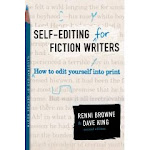
If you’re reading this, then you’ve probably already read a lot about the art and craft of writing – how-to books, articles in both magazines and online, writing blogs. Maybe you’ve joined critique groups to trade feedback with other writers or taken writing classes. Maybe you’ve even read Self-Editing for Fiction Writers.
These various sources of information can often be a lot of help. They can open your eyes to writing techniques you didn’t know about, or help you see problems in your writing that you might not have otherwise noticed. But there’s a danger to all of them – not in the sources themselves, but in the way you approach them. Taken the wrong way, even the best of them can damage your writing. You can avoid this danger, though, if you remember one simple truth.
Sometimes, you need to ignore even the best advice.
A client struggling with his dialogue once asked me how long his sentences should be. He'd heard a writing teacher say that ten words was the limit. I replied that shorter sentences often increase the pace and tension of a story, which is usually a good thing – that’s probably why the teacher gave the advice she did. But it was far more critical for him to listen to his characters. If they were deliberate or rambling, they should speak in longer sentences. The terse or dimwitted should use shorter ones. He was in trouble because he was putting the advice he’d gotten ahead of the people he was trying to create.
The techniques you use in writing your story can’t be separated from the story itself. For instance, if you use more interior monologue to convey a character's reactions to events, your character will seem more introspective. Nor can you write shorter scenes without changing how your plot tension builds. A rule about the right way to structure a plot won’t help when what you need is the right to structure your plot. The best way to convey characters is always whatever is the best way to convey your characters. You need to find the advice that will let you tell your story rather than adapting your story to the advice you’re getting.
Of course, you do need to get advice. Your story may not be working because you're using a particular writing technique in a clumsy way through inexperience or inattention. You may be using an approach that doesn’t fit your story or ignoring another that does. But you can’t treat what you learn as immutable law: "Thou shalt not use dream sequences," "Thou shalt have no narrative summary," "Thou shalt not commit omniscient narration for it is an abomination." Instead, think of writing techniques as tools that let you perform certain tasks as you write.
The key to using any tool intelligently is to understand how it works. So as you’re reading about how often to paragraph, try to see how your writing changes if you paragraph more or less frequently. As you learn ways to work a character’s past into the story, ask yourself how the different techniques would affect the way your readers feel about that character. Then, once you have a feel for what the different tools can and cannot do, focus on your story, on your characters, on the particular vision that is your novel. This will help you choose the tools that will best create your story.
Above all, never follow advice blindly – not even my own. Some of my clients have become clients because they took the advice in Self-Editing for Fiction Writers as if it were commandments from on high – automatically eliminating all –ly adverbs or never writing anything that wasn’t an immediate scene. Sometimes the right thing to do is to ignore advice, even the best advice.
Good writing,
Subscribe to:
Posts (Atom)